
Elementor #8347
Add Your Heading Text Here
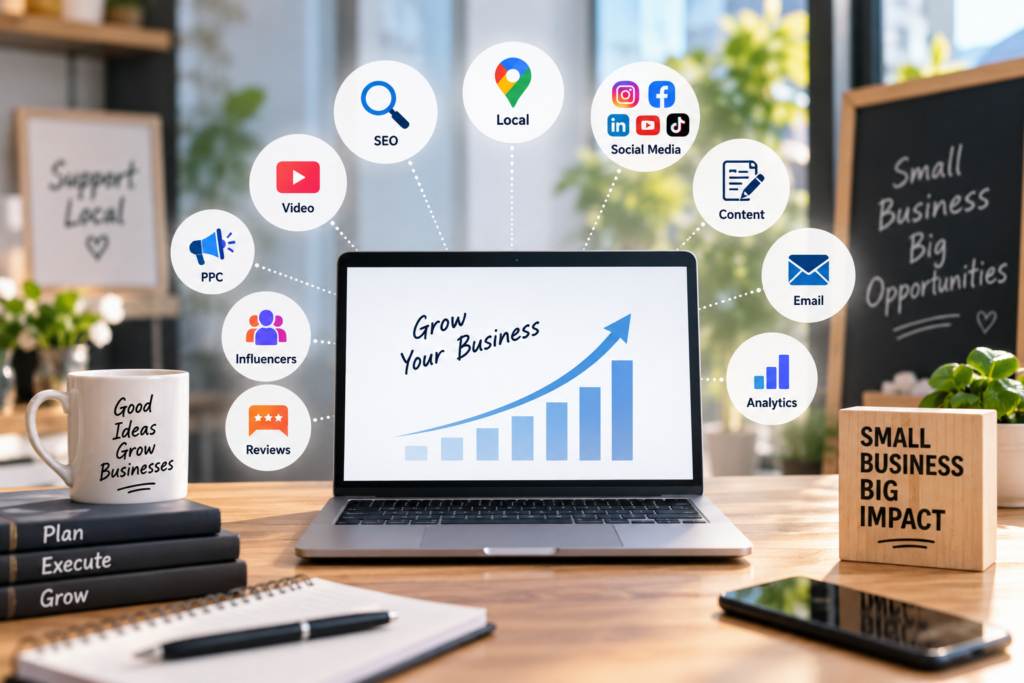
In this article, we will discuss about marketing strategies and how you can leverage your offline business using these simple marketing hacks. There are Top 10 digital marketing strategies for small businesses which you can implement right away and boost your overall online visibility. Proven Top 10 Digital Marketing Strategies for Small Businesses In today’s competitive business environment, having a strong online presence is no longer optional for small businesses. Whether you run a local shop, a startup, a service-based business, or an online store, digital marketing can help you reach potential customers, build brand awareness, generate leads, and increase sales without requiring the massive budgets often associated with traditional advertising. The good news is that small businesses do not need to use every digital marketing channel at once. The key is to choose the right strategies, understand your target audience, create valuable content, and consistently measure your results. Here are the top 10 digital marketing strategies for small businesses that can help build sustainable online growth. 1. Search Engine Optimization (SEO) Search Engine Optimization, or SEO, is one of the most effective long-term digital marketing strategies for small businesses. SEO involves optimizing your website and online content so that it appears higher in search engine results when potential customers search for relevant products or services. For example, a local bakery can target keywords such as “best bakery near me,” “birthday cakes in [city],” or “custom cakes near me.” Small businesses should focus on: SEO may take time to produce significant results, but it can generate consistent organic traffic without paying for every visitor. 2. Local SEO and Google Business Profile For businesses that serve a specific geographic area, local SEO can be extremely valuable. A well-optimized Google Business Profile can help your business appear when people search for nearby products and services. For example, someone searching for “digital marketing agency near me” may see local businesses before traditional organic search results. Small businesses should make sure their profile includes: Encouraging satisfied customers to leave genuine reviews can also improve credibility and influence purchasing decisions. 3. Social Media Marketing Social media platforms provide small businesses with an affordable way to connect directly with their target audience. According to marketing statistics, instead of simply promoting products, businesses should use social media to build relationships and communities. Depending on your audience, platforms such as Instagram, Facebook, LinkedIn, YouTube, and TikTok can be useful. A strong social media strategy can include: Consistency is more important than posting excessively. A business that provides useful or entertaining content regularly is more likely to remain memorable. 4. Content Marketing Content marketing focuses on creating and distributing valuable information that attracts and engages potential customers. Instead of constantly saying “buy our product,” businesses can answer the questions their customers are already asking. For example, a fitness business could publish articles such as “Beginner’s Guide to Strength Training” or “10 Common Workout Mistakes.” Content can include: High-quality content can also support SEO and digital media marketing, making content marketing one of the most versatile strategies for small businesses. 5. Email Marketing Email marketing remains a powerful way to communicate with existing customers and leads. Unlike social media, where algorithms determine how many people see your content, an email list gives businesses a direct communication channel with their audience. Small businesses can use email marketing for: The most effective emails provide value rather than constantly pushing sales. Segmenting your audience based on their interests and previous interactions can make campaigns even more effective. 6. Pay-Per-Click Advertising (PPC) While SEO focuses on organic visibility, Pay-Per-Click advertising allows businesses to pay for immediate visibility on platforms such as Google and social media networks. PPC can be particularly useful when a business wants quick results, promote a specific offer, or generate leads for a particular service. However, small businesses should avoid spending money without a clear strategy. Start with a limited budget, identify high-intent keywords or audiences, create multiple advertisements, and track conversions. Important metrics include: The goal is not simply to generate clicks but to generate profitable customers. 7. Video Marketing Video has become one of the most engaging formats for digital audiences. Small businesses can use video to demonstrate products, explain services, answer customer questions, and showcase their personality. You do not necessarily need expensive cameras or production equipment. A smartphone, good lighting, clear audio, and useful content can be enough to get started. Some effective video ideas include: Short-form videos can also help businesses reach new audiences through social media discovery features. 8. Influencer and Creator Marketing Small businesses do not always need to work with celebrities or large influencers. Micro-influencers and niche content creators can sometimes provide better access to highly relevant audiences. For example, a local restaurant could collaborate with food creators in its city, while a skincare brand could work with creators who focus on beauty and skincare. When selecting an influencer, consider: The number of followers should not be the only factor. A smaller creator with an engaged and relevant audience may generate better results than a large account with limited audience interest. 9. Customer Reviews and Online Reputation Management Trust plays a major role in purchasing decisions. Before choosing a business, many customers look at reviews, ratings, testimonials, and online discussions. Small businesses should actively manage their online reputation by encouraging genuine customers to share their experiences. Businesses should also respond professionally to both positive and negative reviews. A thoughtful response to a complaint can demonstrate that the business values its customers. You can also display authentic testimonials and case studies on your website and social media platforms. Remember: never buy fake reviews. Building genuine customer trust is much more valuable for long-term growth. 10. Analytics, Automation, and AI One of the biggest advantages of digital marketing is the ability to measure performance. Small businesses should use analytics tools to understand where visitors come from, which campaigns generate leads, and what actions customers take before making a purchase. Track important metrics such as:
Top 10 digital marketing strategies for small businesses Read More »
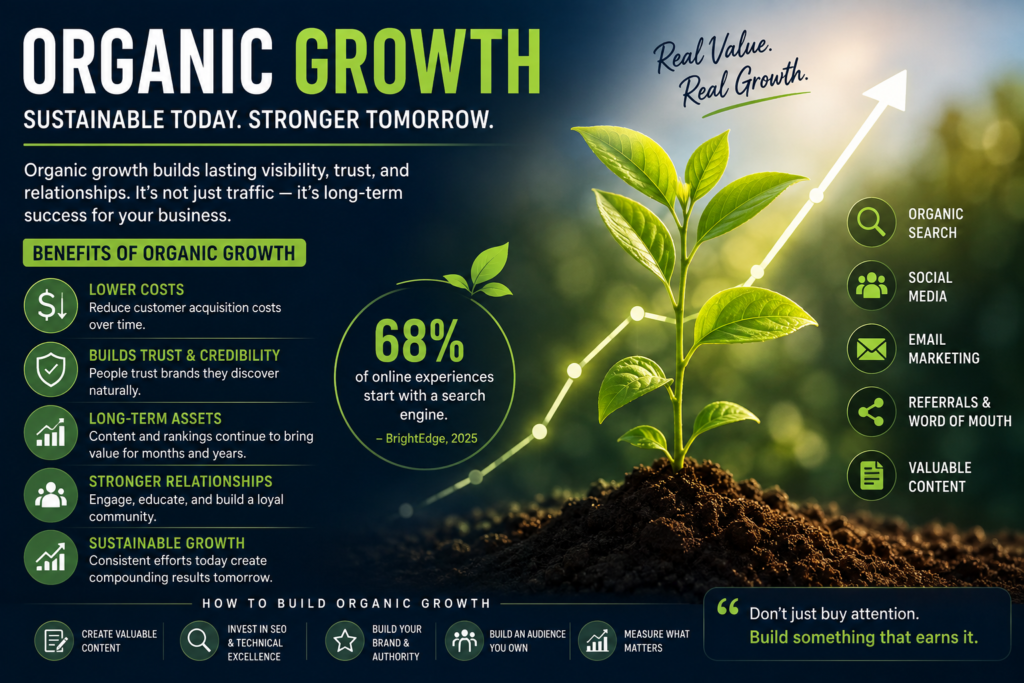
Organic Growth in 2026: Benefits, Strategies and Why It Matters for Businesses In today’s competitive digital world, businesses are constantly looking for ways to attract customers without depending entirely on paid advertising. While Google Ads, social media advertising, and other paid campaigns can generate quick results, organic growth offers something much more valuable in the long term: sustainable visibility and customer trust. Organic growth refers to increasing website visitors, leads, customers, brand awareness, and revenue through unpaid channels such as search engines, social media, referrals, communities, email, and valuable content. For businesses that want to build a strong digital presence in 2026, organic growth should be an important part of their marketing strategy. What Is Organic Growth? Organic growth is the process of growing a business naturally through customer discovery, valuable content, search visibility, word-of-mouth, social engagement, referrals, and other channels that do not require direct payment for every visitor or interaction. For example, when someone searches Google for “best digital marketing agency,” discovers your website, reads your article, and eventually contacts your business, that customer acquisition can be considered part of organic growth. Similarly, a customer discovering your Instagram page through a shared post, subscribing to your newsletter, or recommending your business to a friend can contribute to organic growth. The objective is not simply to generate traffic. It is to build an audience that continues to discover, trust, engage with, and recommend your brand. Why Is Organic Growth Important Today? The digital landscape is becoming increasingly expensive and competitive. Businesses are competing for advertising space across Google, Meta, YouTube, TikTok, LinkedIn, and other platforms. Organic channels can provide an important counterbalance. BrightEdge’s research published in 2025 found that AI search was growing rapidly but still accounted for less than 1% of referral traffic in its dataset, while organic search remained the primary driver and produced stronger conversion performance. This demonstrates an important point: new technologies are changing how people discover information, but traditional organic visibility remains highly valuable. 1. Lower Customer Acquisition Costs One of the biggest advantages of organic growth is that you don’t necessarily have to pay for every visitor. With paid advertising, stopping your campaign generally stops the flow of paid traffic. Organic content can continue attracting visitors after it has been published. A well-optimized article, YouTube video, social media post, or resource page can potentially generate traffic for months or even years. This does not mean organic marketing is free. Businesses still need to invest in strategy, content creation, SEO, tools, and expertise. However, the economics can become more attractive as a strong content and search presence compounds over time. 2. Builds Trust and Credibility People are increasingly exposed to advertisements everywhere they go online. Organic discovery can feel more natural because users actively find information rather than simply being shown an advertisement. Google’s current guidance emphasizes helpful, reliable, people-first content and recommends demonstrating first-hand expertise, originality, and trustworthiness. For businesses, this means creating content that genuinely solves customer problems instead of producing articles simply to rank for keywords. Educational guides, case studies, tutorials, original research, customer experiences, and expert opinions can help establish authority. 3. Creates Long-Term Digital Assets Paid advertisements are campaigns. Organic content can become an asset. For example, a company that publishes 100 useful articles over several years is building a searchable knowledge base that can continue generating visibility. HubSpot’s 2025 blogging research found that 66% of businesses maintaining blogs publish content for brand awareness, 53% for customer engagement, and 49% for lead generation. This shows that blogging is not only about SEO. Businesses also use content to build awareness, engage audiences, and generate potential customers. 4. Organic Growth Can Support Multiple Channels A strong organic strategy does not have to depend exclusively on Google. One piece of content can be transformed into multiple formats: HubSpot’s research found that 83% of businesses with blogs distribute their content through social media, while 47% use email newsletters. This makes content repurposing an important strategy for businesses trying to maximize the value of their marketing efforts. 5. Organic Search Still Matters in the AI Era Artificial intelligence is changing search, but businesses should not assume that SEO is dead. Instead, SEO is evolving. Google recommends creating content primarily for people rather than producing large quantities of content simply to attract search traffic. Its guidance also emphasizes original information, comprehensive answers, first-hand expertise, and clear authorship where appropriate. The future of organic growth therefore involves creating content that can perform across traditional search engines, social platforms, and AI-powered discovery experiences. How to Build an Organic Growth Strategy A successful organic growth strategy can be built around five core areas: 1. Create valuable content: Answer real questions your target customers are asking. 2. Invest in SEO: Research search intent, optimize important pages, improve internal linking, and maintain strong technical SEO. 3. Build your brand: Develop recognizable expertise through consistent content and communication. 4. Build an audience you own: Encourage visitors to subscribe to newsletters, communities, or other direct communication channels. 5. Measure business outcomes: Don’t focus only on pageviews. Track leads, conversions, revenue, returning visitors, rankings, engagement, and customer acquisition costs. Organic Growth vs Paid Marketing Organic and paid marketing should not necessarily be treated as competitors. Paid advertising can provide immediate visibility and help businesses test offers, audiences, and messaging. Organic marketing can build long-term visibility, authority, and trust. The strongest strategy for many businesses is therefore a combination of paid and organic marketing. Use paid campaigns when you need speed. Build organic channels when you want sustainable growth. Conclusion Organic growth has become more important, not less, in today’s digital environment. Businesses are facing rising competition, changing search behavior, increasing advertising costs, and the rapid growth of AI-powered discovery. In this environment, brands that consistently provide useful information and build genuine relationships with their audiences can create a significant long-term advantage. Organic growth is not a shortcut. It requires patience, consistency, quality, and measurement. But when done correctly, every useful article, video,
Organic Growth in 2026: Benefits, Strategies and Why It Matters for Businesses Read More »
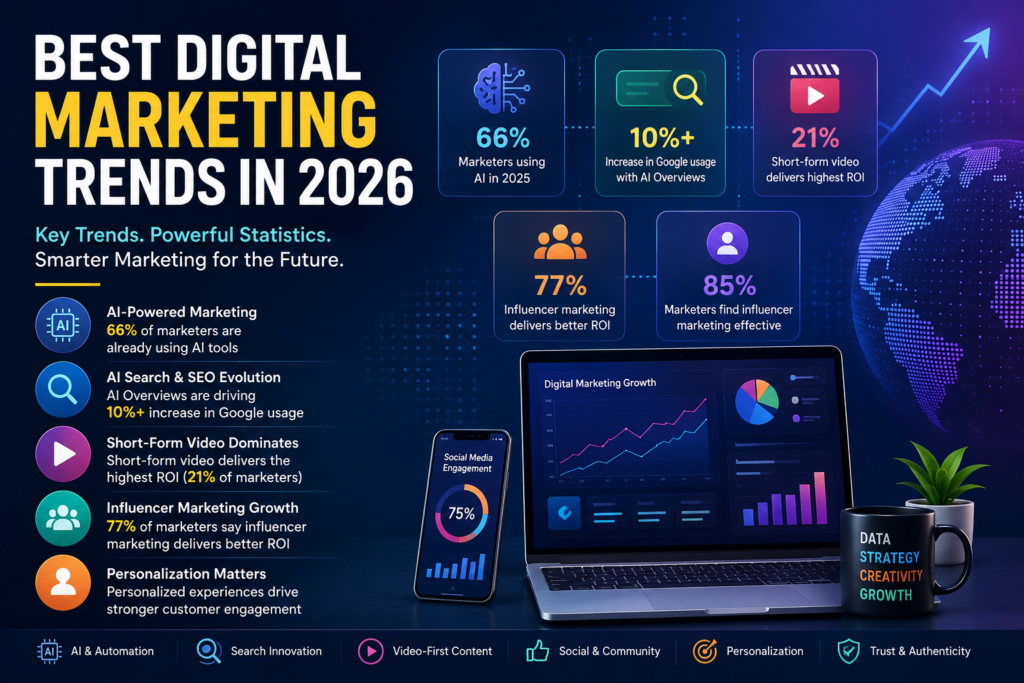
Digital marketing is changing faster than ever. Artificial intelligence, short-form video, social commerce, search innovation, and data-driven personalization are reshaping how businesses attract customers online. For brands that want to remain competitive in 2026, simply having a website and running advertisements is no longer enough. Here are the most important digital marketing trends businesses should watch in 2026, backed by recent industry statistics and research. 1. Artificial Intelligence Is Becoming a Core Marketing Tool Artificial intelligence has moved from being an experimental technology to an everyday marketing tool. Marketers are using AI for content creation, customer research, data analysis, campaign ideas, personalization, and automation. According to HubSpot’s 2025 research, 66% of marketers globally were already using AI in their roles. Content creation was one of the most common applications, with marketers using AI to create copy, images, ideas, and other marketing assets. The important trend for 2026 is not simply “using AI to write content.” Businesses are increasingly combining AI with human expertise to produce content faster while maintaining originality, brand voice, and credibility. What businesses should do: Use AI for research, brainstorming, content repurposing, analytics, automation, and personalization—but keep human review and strategic thinking at the center. 2. SEO Is Evolving Into AI Search Optimization Search engine optimization is changing because people are increasingly receiving answers directly from AI-powered search experiences. Google has expanded AI Overviews to more than 200 countries and territories and more than 40 languages. Google also reports that in major markets such as the U.S. and India, AI Overviews are driving more than a 10% increase in Google usage for the types of searches where AI Overviews appear. This means businesses need to think beyond traditional rankings. Content should be structured so that search engines and AI systems can easily understand the topic, identify trustworthy information, and connect the content with relevant user questions. What businesses should do: Focus on helpful, original content, strong topical authority, clear answers, structured information, first-hand expertise, internal linking, and authoritative references. 3. Short-Form Video Continues to Dominate Short-form video remains one of the strongest digital marketing formats across platforms such as Instagram, YouTube, and TikTok. HubSpot’s 2025 marketing research found that short-form video was the content format delivering the highest reported ROI, with 21% of marketers selecting it. It was also the most-used content format, with 29% of marketers reporting its use. Video marketing is also widely adopted. HubSpot’s compilation of 2025 video marketing research reports that 89% of businesses use video marketing, while 93% of marketers consider video an important part of their overall strategy. What businesses should do: Create short educational videos, product demonstrations, customer stories, behind-the-scenes content, FAQs, and quick industry tips. One long-form piece of content can also be repurposed into multiple short videos. 4. Social Media Is Becoming a Search and Discovery Channel Social media is no longer only about posting updates and building followers. Users increasingly discover brands, products, restaurants, services, and information through social platforms. HubSpot’s research found Instagram, YouTube, and TikTok among the strongest platforms for driving traffic, engagement, and audience growth. Instagram led the survey for site traffic, engagement, and audience growth. This creates an opportunity for businesses to optimize social profiles and content similarly to how they optimize websites. What businesses should do: Use descriptive captions, relevant keywords, strong hooks, searchable titles, location information where relevant, and content that directly answers customer questions. 5. Influencer Marketing Is Moving Toward Micro-Creators Influencer marketing is becoming more focused on authenticity and niche communities rather than simply choosing celebrities with millions of followers. HubSpot reports that 77% of marketers said influencer marketing delivers better ROI than other channels, while 85% considered it effective. The research also found that 67% of marketers work with micro-influencers. For smaller businesses, this can be particularly valuable because niche creators often have highly engaged audiences. What businesses should do: Partner with creators whose audience matches the target customer rather than choosing influencers based only on follower count. 6. Personalization and First-Party Data Will Become More Important Customers increasingly expect brands to understand their needs and provide relevant experiences. At the same time, businesses need to become more careful about privacy and how customer information is collected and used. The future of digital marketing will therefore combine personalization with responsible first-party data collection. Businesses can use website interactions, email subscriptions, purchase history, customer surveys, and CRM data to understand audiences while maintaining appropriate consent and privacy practices. What businesses should do: Build email lists, improve CRM systems, segment audiences, and personalize campaigns based on genuine customer behavior. 7. AI + Human Creativity Will Be the Winning Combination The biggest digital marketing trend may not be AI replacing marketers—it is marketers who know how to use AI effectively outperforming those who do not. HubSpot’s research found that 72% of marketers in its global social media trends research reported better performance with AI-assisted content, while 71% reported actively using AI tools in social media marketing. However, automated content alone is unlikely to create a strong brand. Original experiences, expert opinions, customer stories, creativity, and trust remain important differentiators. Conclusion The digital marketing landscape in 2026 is centered around AI, search innovation, video, social discovery, influencers, personalization, and authentic content. Businesses should not try to chase every new platform or technology. Instead, they should build a strong foundation around valuable content, search visibility, social media, customer data, and measurable campaigns. The brands most likely to succeed will be those that combine technology with human creativity and customer understanding. Digital marketing is no longer simply about reaching more people. It is about reaching the right people, in the right place, with the right message—and increasingly, using AI to do it faster and smarter. Sources: HubSpot, Google Search, Google India, and industry research referenced throughout this article.
